The brief came in like most of the best ones do — an email, late on a Tuesday, with a handful of names I half-recognised and a deadline I needed to think hard about. Local Enterprise Office Meath are launching a campaign called Meath Made: Where Creativity Began. We need to photograph all the makers ahead of Bloom. Are you available?
The answer was yes. The answer is almost always yes for a project like this. Here's how it came together, and what I learned about photographing makers in their natural habitat.
The brief, in plain English.
Bord Bia's Bloom in the Park is the country's biggest annual food, garden and lifestyle festival. Each year, every Local Enterprise Office in Ireland sends a delegation of makers, artists and producers to showcase what their county does best.
For 2024, LEO Meath had selected a group of makers spanning woodwork, textiles, ceramics, illustration and art. The campaign needed to do two jobs at the same time. It had to introduce each maker individually, with their work, in a way that would carry the spirit of what they do. And it had to give LEO Meath a strong, consistent brand identity — one visual language across very different crafts, so that whether you saw a poster, a press release, or an Instagram tile, you knew immediately it was part of the Meath Made story.
That second job is the harder one. The temptation is always to over-style, to bring everyone into one location, dress them in matching aprons, and call it consistency. That isn't what makes a brand campaign feel real. Consistency, when it's done well, comes from treatment — the way every shot is lit, framed, and pulled together — not from forcing everyone into the same costume.
Where the work actually happens.
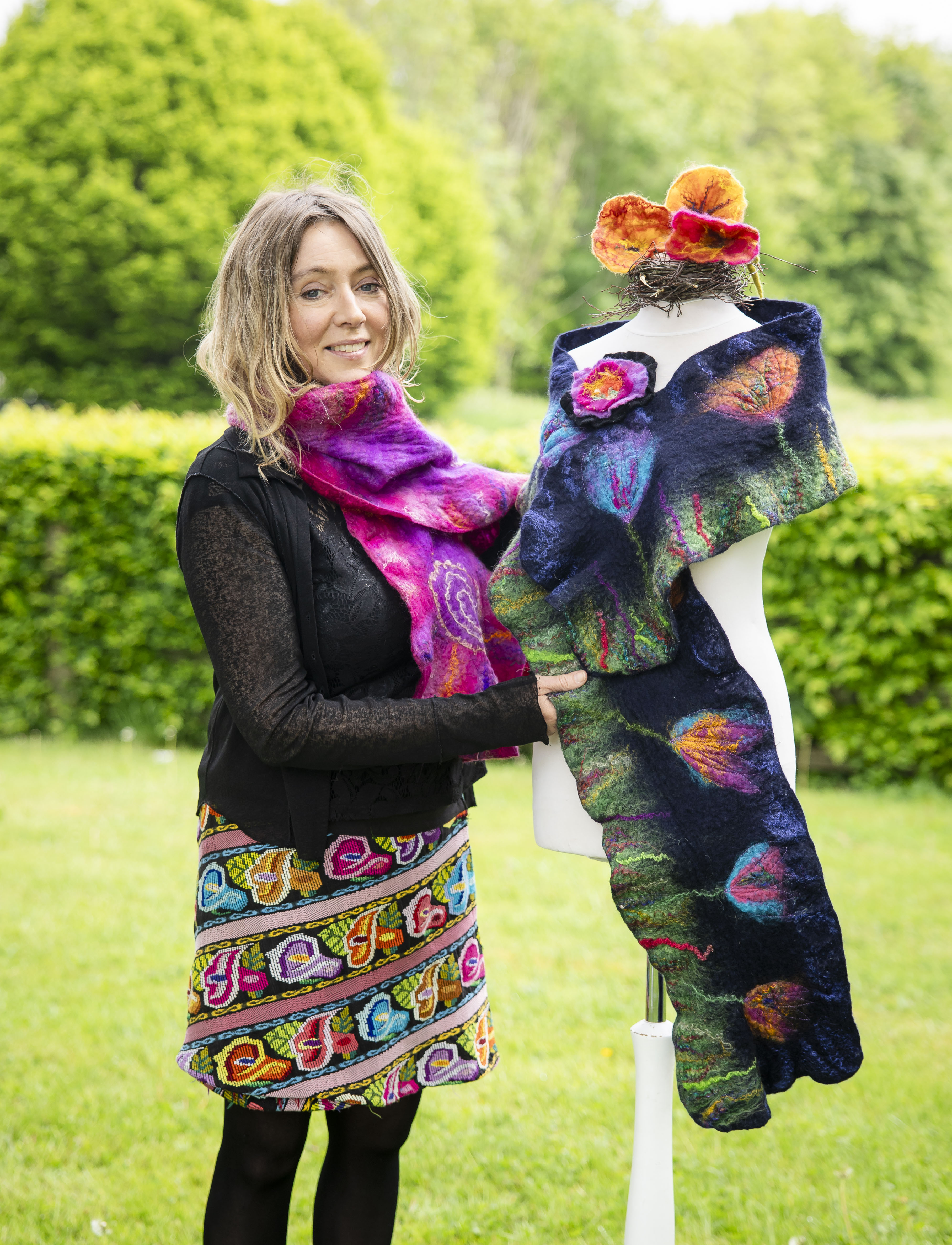
Each of the makers does what they do somewhere specific. Frayne Woodcraft works in a workshop full of wood shavings and old saws. The felt artist works with rolls of fibre that take a hundred hours each to become a wearable garment. The ceramicist works in a small back-garden studio with a kiln that smells faintly of summer.
The right thing to do, photographically, was to bring each of them outside, into the same context: the green of a Meath field. The makers stood with their work, on the grass, in the same flat overcast light that's frankly the only weather Ireland reliably delivers in spring.
The visual rule of the campaign was simple: maker, work, grass.
That sounds like nothing. But the discipline of not adding things is half of brand photography. Every shoot day, the temptation is to pile in props, change locations, set up something visually clever. The discipline of staying with one frame, repeated for every maker, is what makes the final set feel like a campaign rather than a portfolio.
What happened with the wooden chair.
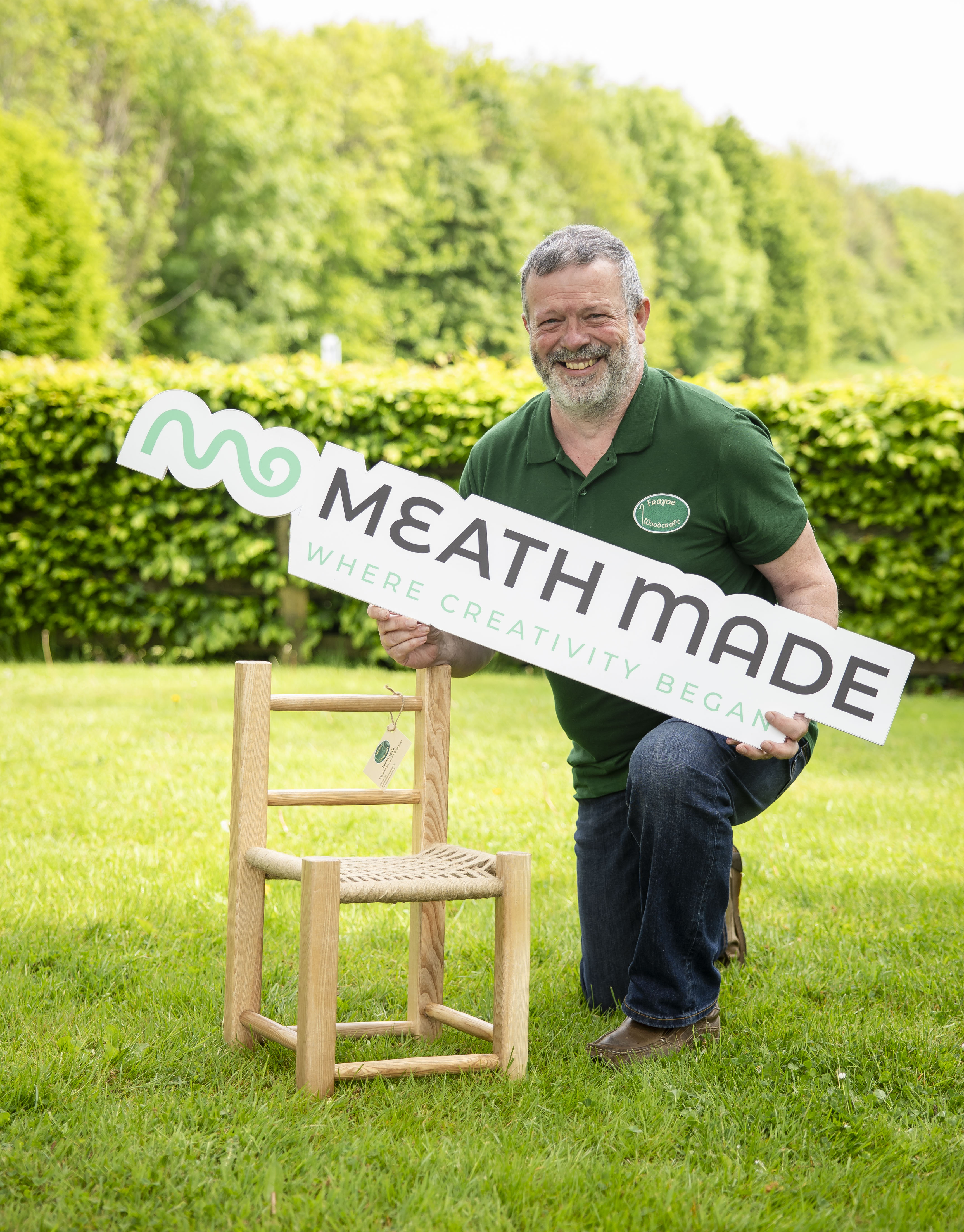
I had a list of items each maker would bring. Frayne had said he'd bring "a piece" — I assumed something compact. He arrived with a hand-woven seat chair he'd built that week, and it was beautiful. It was also, as it turned out, not light.
We tried six different positions for that chair across the field. Sitting on it. Standing behind it. Holding it. Carrying it like a flag. The chair would not behave. The grass was uneven. The chair leaned. The light moved.
The shot we ended up using was the one I almost didn't take — Frayne kneeling beside the chair, both hands on it, the way a sculptor stands beside a piece they love. Not posed. Just steadying it. Once you start photographing makers, you realise how much they touch their work without thinking. That's the gesture that ended up telling the story.
The group launch shot.
The launch photograph was the hardest of the day, and I knew it would be. Group shots are always the hardest. With makers, especially — people who are used to working alone in their studios — standing shoulder-to-shoulder under a tree with the Cathaoirleach of Meath County Council asks a lot.
The trick I use for any group photo is the same one I use for anxious headshot clients. Don't ask them to pose. Ask them to look at each other. Ask them to laugh at something the person beside them just said. Most of the joy in a group portrait comes from the second after the laugh, when nobody has put their face away yet.
The launch shot you can see on my PR page is the third frame after I told someone something extremely silly. The person beside her is laughing because she's laughing. That's the picture.
Need photography for a brand campaign?
PR, editorial and brand campaign work for businesses, councils, agencies and organisations across Ireland. Studio in Enfield, Co. Meath, travelling everywhere.
See PR & Editorial Work →Why projects like this matter.
It's tempting to think of brand campaigns as the glossy end of the photography business — the part with budgets, agencies and large clients. Some of them are. This one wasn't.
Meath Made was about a group of mostly one-person businesses, people who pour everything into their craft and don't have a marketing department. The point of the campaign was to give them a single, professional set of images they could use for the next two years. Press kits. Instagram posts. Bloom signage. Funding applications. A photograph isn't an end in itself for a maker — it's the thing that lets the rest of the world meet them.
That's the work I find most satisfying. Not because of the prestige or the location or the celebrity factor (though those projects are fun too — see the work I've done for RSVP, VIP and Funds Europe). It's satisfying because you can see the photographs working in the real world afterwards. On a website. On a leaflet at a market stall. On a poster in a community hall in Trim.
What I'd tell anyone planning a similar campaign.
Three things, briefly.
One: pick a visual rule and stick to it. One backdrop type. One light direction. One framing logic. Whatever it is, repeat it. Consistency is the whole point of a brand campaign.
Two: photograph people doing what they do. Not what you imagine they should be doing. The felt artist looks like a felt artist when she's draping fabric, not when she's standing with her hands by her sides. Let your subjects move. The honest pictures are in the movement.
Three: trust the makers. They know their work better than you do. Ask them what they want to be photographed with. Ask them what they wish people understood about what they make. The shoot becomes a conversation, and the photographs follow.
Meath Made went to Bloom in the Park in summer 2024. The campaign images are still being used a year later, which is, in my book, the highest compliment a brand photograph can get.
If you've a project in mind, I'd love to hear about it.